Sunday, September 28, 2008

So Long and Thanks for All the Fish. . .

Thanks Blogger, for all you've done for me over the last two years.

Monday, September 22, 2008

Ghost Town


"Ghost Town" is one of those minor miracle films that one who pays enough attention to film release schedules and box office grosses is always surprised to see pop up. For one thing, it's three main actors are somewhat well known, but none of them are major money makers-one of them is very famous in the United Kingdom, but not exactly at the pinnacle of fame in America. And it also is opening on a very crowded weekend for movies, and in the middle of September which is commonly a dumping ground for studios as they get ready for their big award pushers. So it was no surprise to me when Dreamworks decided to slash their release for "Ghost Town" a whole thousand screens, but it was a surprise to me when the film actually turned out to be very very good-a somewhat conventional romantic comedy formula that is elevated by three terrific performances. 

Ricky Gervais is known to some folks here, mostly as the creator of the British version of "The Office," and than a somewhat popular HBO show "Extras." Aside from a few bit parts in some American films-"Night at the Museum," and "For Your Consideration" off the top of my head-this is his first top billing role. He plays Bertram Pincus, a most unpleasant dentist who just wants to be left alone. When his fellow dentist comes in and tells him that the receptionist had a baby recently, Bertram gives a small smile, but soon runs away while everyone's back is turned. He is rude to nearly everyone. On the gurney for his colonoscopy, he comments on the entire lack of privacy, and how one of the doctors looks like he is "on a field trip to the hospital." While on the operating table he ends up dying for seven minutes, and when he is revived he discovers that he has the ability to see dead people. Not decayed and disturbing like the dead people in "The Sixth Sense," but looking quite like they did when they were alive-even wearing what they died in. He is annoyed by several of them asking him to complete some unfinished work, and this is where he meets Frank (Greg Kinnear). Frank died by getting hit by a bus, right after a phone call with his wife Gwen (Tea Leoni) where she discovered that he was having an affair. She is getting remarried to a bad man, and Frank wants Bertram to try and stop it-and if he does it, than all the dead people will stop bothering him. 

Gervais certainly isn't going very far from his bitter characters roots with this, but that is really what he knows. It certainly is a nice test to adjust him to American audiences, especially if he wants to be in future projects. He is very funny playing a character that wants to be anything but funny. Upon our first meeting with him-where he shoves some cotton into the mouth of a patient who will not shut up-we know exactly what type of character arc to expect from Bertram, but Gervais elevates this formulaic material into something much funnier and much more enjoyment. I was reminded of this year's "Smart People," which took a common mid-life crisis indie story and turned it into something much smarter. Gervais and the wonderful dry and sarcastic Tea Leoni have a few winning scenes together-and during the obvious "confession' scenes towards the end, work well to boost us out of some rather conventional moments. And lastly there is Greg Kinnear, who brings a surprising amount of poignancy to the role, as a man who is seeing all of his flaws too late. And what really adds to the surprise of this film is how under the radar these three actors are to the common audience. But it proves that to make a successful comedy one doesn't need to go straight to the common comedic choices-they just need to get good actors. Leoni has been very funny in films like "You Kill Me" or "Flirting with Disaster." Why isn't she ever given a chance to showcase these talents a bit more?

The script-written by David Koepp, oddly enough-does cover its familiar ground, but also has its charm and originality. I liked the concept of the living having unfinished business, and how that prevents the dead from being able to move on. It was a nice twist to the typical dead wanting their last say in things, which is actually something that really divided this film from "The Sixth Sense," which one must draw comparison to. Koepp's script does a good job balancing the comedy and the heart, which comes in during the second half, including a very sweet montage where Bertram finally begins to go about helping the dead folk. And Gervais manages the dramatic areas of the film well too, but never losing that charm that makes him such a good comedian. I was upset we never saw him kiss Leoni, just for my own personal curiosity of what it looks like for David Brent to kiss someone.

It's hard to write a lot for a film like "Ghost Town," which is just a pleasant, funny, and rather sweet trip to the movies. A comedy that is subtle with its jokes, rare for a movie getting a big release in an odd release schedule. It has its flaws, yes-mostly just the familiarity of the story. But its execution (no pun intended) is better than the average romantic comedy, and the performances penetrates the funny bone many times. I hope it has legs because its one of the better mainstream films that is around at the moment, and a great boost for Gervais as a leading man.

*** of ****

Thursday, September 18, 2008

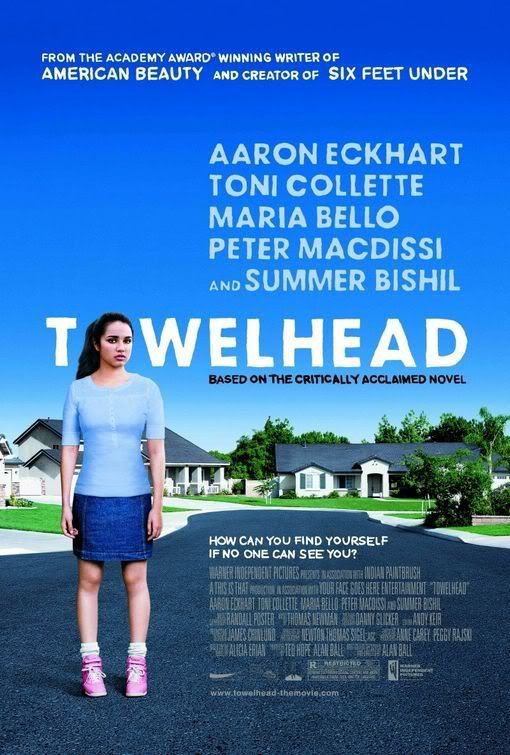
Towelhead


Alan Ball is one of those writers whom when mentioned one either shakes their head in disgust at his work, or finds him to be a complete genius. And then of course there are those that have no idea who he is, but those need not be mentioned. Simply put, they don't know what they're missing. Hopefully you know what a daring, lurid, and interesting writer Alan Ball is. He blew me away with his writing debut in 1999 with "American Beauty," and I really enjoyed his television show "Six Feet Under" earlier in the decade. Of course when I learned that he was not only writing a new film, but also making his directing debut, my interest was at its peak. And of course when this film was premiering at the 2007 Toronto Film Festival, which I was in attendance, I wanted to do everything that I could to get a ticket for it.

Truthfully I haven't actually seen "Towelhead." I saw "Nothing Is Private," the film under its original (and in my opinion, better) title, about a year ago, and the very first cut version. I heard that nothing has been cut or changed except for the opening credit, and if that is truth than I can safely say that this is one of the best films of the year. Here we have a film of such raw emotion and extreme edginess, but never seeming like it is exploiting its main character for the sake of controversy.

Here our main character is Jasira (played by nineteen year old Summer Bishil, who warrants and Oscar nomination but probably won't receive one). Jasira, thirteen, lives with her distant mother (Maria Bello). When her mother's boyfriend ends up shaving Jasira in a moment of weakness (down there. . .), she sends her to live with her father Rifat. Ball revisits themes that he knows here, sending Jasira to suburbia, where privacy is something that is hardly practiced. Her father disapproves of almost everything, refusing to allow her to go out with Thomas-a good kid in Jasira's school, but Rifat doesn't like the fact that he is black. He does approve of Jasira babysitting Zack, a boy next door that introduces her to the word Towelhead, which he learned from his father Mr. Vuoso (played perfectly by Aaron Eckhart.) Mr. Vuoso is an Army reservist, and classifies Rafit as a lover for Saddaam and everything that he stood for. The only person that seems to actually care about Jasira, and to make sure that she is able to live her life, is her next door neighbor, the very kind and every pregnant Melina (Toni Collette). But Jasira's young adult life is soon shattered by her advanced looks, her very unprivate life, and her interest in sex that is beyond her years.

Ball has a knack for showing us scenes, images, and concepts that would make the average viewer get a bit uncomfortable in their seats. However these are things that actually happen in reality, and that actually advance the plot and enhance the characters instead of having the viewer feel like he is exploiting them. This very personal look into Jasira's life-the start of her periods, her losing her virginity, her discovering masturbation-are probably things that we wouldn't want to see, but just highlight the unprivate nature of the films major theme. I am quite upset at the title change, and still have a hard time adjusting to it. In crafting these characters, Ball does sometimes go back to the classic suburban formula, and giving most of his characters a few over the top qualities. But at the same time he gives them an odd humanity, grounding the film into a more realistic tone than one may think. For example, Jasira's father is a racist and somewhat cruel person, but from time to time he would show a different side to himself, if not for a mere second. And then he will literally unredeem himself a moment later. Such is life. Such are people.

I mentioned Summer Bishil's performance already, which is raw and very mature for such a young actress. She will be forgotten by the Academy at year's end, which is a shame. If Ellen Page can get nominated for a good performance in "Juno," than surely Summer Bishil can get nominated for a great performance here, but I say that quite sarcastically. Alongside older and very talented actors like Eckhart, Bello, and Collette, Summer Bishil really does hold her own. Aaron Eckhart is one of those actors that can drift from playing a lovable character to a downright nasty villain (as ironically seen in "The Dark Knight," which I hadn't seen when I saw this film.) As Mr. Vuoso, there is a small amount of humanity in him, and Eckhart really manages to subtly bring it out in him, but for the most part he is a creep of a man. It is their scenes together that really were the films highlights-giving us a great balance of extreme seediness and extreme innocence, where one clearly overpowers the other.

As for Ball's direction-I hardly have any quips about it. There is a certain feeling of dread when a good writer ends up doing a directing debut. There is a feeling that he might end up putting more effort into one aspect than another. That was the problem with Mike White's debut "Year of the Dog," where instead of a directing style he just put his characters in the center of the screen-very uninspired and not very creative. But Ball does a few neat touches. I think it was a good move that he revisited themes that he did in the past, because it gave him a chance to get used to the directing gears for future projects, where I hope he does things a bit differently storywise. "Towelhead" is certainly an impressive debut for Ball, and it's sure to be one of my favorite films of the year.
**** of ****

Sunday, September 14, 2008

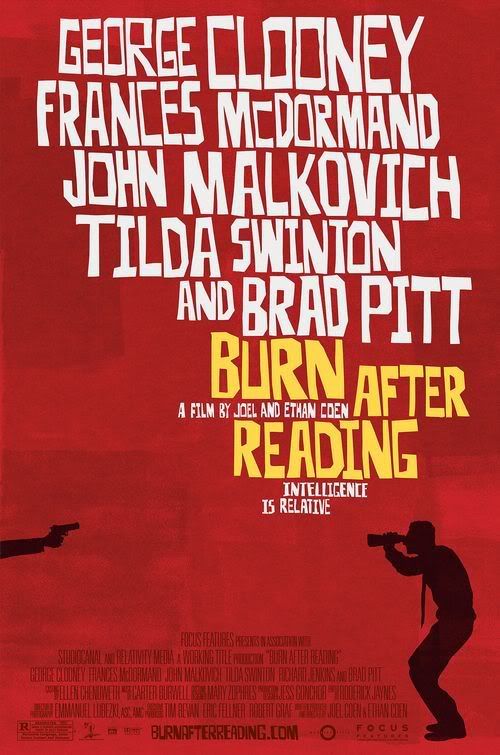
Burn After Reading


It only took twenty years, and about a dozen terrific pictures, but the Coen Brothers have finally got into the more public spotlight, and the wide release and rather large box office take (their largest to date) for "Burn After Reading" is strong evidence of that. Perhaps now their films won't be released into the obscure only to appear on DVD a few months after their release. But it's clear that even after winning the Oscar last year for "No Country for Old Men" that the Coens are not crossing the line into the mainstream, and "Burn After Reading" is vintage Coens from beginning to end-from their classic low camera angles, to their "man at the desk" trademark that seems to appear in every film that they've ever done. 

I will be as quick as possible with the plot, as this is a film where the less you know the better. The film begins off in Langley, Virginia, where CIA analyst Osbourne Cox (John Malkovich, as sleazy and sardonic as ever) is released from his job (no reason is really given except that he has a drinking problem.) Telling his wife Katie (Tilda Swinton) that he quit, he begins to work on his memoirs. Katie is meanwhile having an affair with Harry (a bug-eyed anti-Cary Grant-esque George Clooney), who is also married but enjoys going to internet dating services to meet and lay women. His latest prey is Linda (Frances McDormand), who works at Hardbodies Fitness Center, along with Chad (a gleefully over the top Brad Pitt). It is here where the meat of the story comes into play. Katie wishes to divorce Osbourne and her divorce lawyer has her get a CD containing his financial statements. This CD ends up in the hands of Chad, who teams up with Linda to try and get some kind of blackmail reward for it, as they think it contains some truly secret information. Linda wants the money to pay for four plastic surgeries in her quest to "re-invent" herself. And its from here that the fates of these five characters, and a small handful of others, come together.

The real ingenious part of "Burn After Reading" is how the main catalyst for this story is a CD-ROM that really doesn't contain any type of important information. Nobody outside of Linda and Chad really have any reason to care about its contents. And this is why the real meat of the film is that nearly every character in this film is a complete idiot, leading to one of the most frustratedly brilliant third acts in the recent memory (aside from the nearly perfect third act of "In Bruges" from earlier this year.) And our ending is just as sudden as the one for "No Country for Old Men," but still on the most satisfactory note. We don't get big finales for all of the characters here, and the last scene starts without the audience knowing that this is the end, and it really hits the nail on the head for how insignificant this story is in the grand scheme of things, and it also features J.K. Simmons is one of his most memorable roles, despite the fact that he's only in two scenes throughout.

As for the performers, there is good work from everyone involved, though some better than others. I already noted J.K. Simmons as a highly memorable character, both in character and through quotes. The best of the ensemble is probably John Malkovich, who is great as the frustrated, confused, and rather sick Osbourne Cox. After that is Brad Pitt, who does get last billing but is as hilarious as ever. Pitt really does take advantage of his "pretty boy" looks, and turns them into one ingeniously witty character. Chad is a real fitness freak at heart, clad with his red gym outfit and his iPod strapped to his shoulder. Clooney and McDormand do some good work, and its fun to have the lead actress not be an icon of beauty, which is actually addressed in the film. And lastly Tilda Swinton is clearly having fun with her very cold and icy Katie Cox, who is ironically a children's doctor.

As for the Coens-I really don't think we have to worry about them falling into the mainstream after all of this attention they've gotten. They really do stick to their roots, and allow the average audience to get enjoyment out of it. This isn't the strongly over the top comedy the ads seem to make it out to be, but those who enjoy black comedy will get strong entertainment out of it. The Coens also keep their typical angles and styles. Their quick edits on conversations, as well as the abundance of low angles-we are always looking up at their characters. And lastly their classic "man at the desk" image, of a man of rather high stature being seen behind a desk, prominent on their throne of glory. In this case its clearly J.K. Simmons, but its such a repeated image in their films that it is always worth mentioning. They did stray away from their usual cinematographer, Roger Deakins, who was nominated last year for his work on "No Country," but he had commitment to another film-Deakins was missed, but the film looks as crisp and clear as ever. It is always amusing watching a Coen Brothers film in a packed theatre to catch audience reaction. It's very rare that the entire theatre erupts into laughter at the same time-rather we have scattered reactions, which really do show how many different crowds their brand of humor relates to. "Burn After Reading" is not their best film, but it is very funny, very entertaining, and a great antidote to the powerful dark "No Country for Old Men" last year.

***1/2 of ****

Saturday, September 06, 2008

Mister Foe


I must admit I do not know much about Jamie Bell, a well received British actor who sparked interest when he appeared in 'Billy Elliot" in 2000. My only real exposure to him in a real leading role was in the Lars von Trier penned "Dear Wendy," a film I liked but did not have many comments regarding the young Bell. And now he appears in "Mister Foe," given a very depth-filled role in a very memorable little film. "Mister Foe" is a very gentle and well acted drama, which could have went a very different direction in terms of execution. Made in the United Kingdom, I have a feeling that had it been made in the United States, or in the hands of a more incompetent director, "Mister Foe" could have gone a more quirky and generic indie route. The eccentricities of its main characters are treated in a very human and natural way, instead of using them for cheap laughs or unnecessary comedy. And this is done, not only through the very realistic screenplay, but also the natural performances by the entire cast.

Bell plays Hallam Foe, who spends his days and nights spying on various members of his family and his neighborhood. Obsessed with his dead mother, whose photo appears very large on the wall of his treehouse, Hallam spies on his stepmother Verity, and his father Julius (Ciaran Hinds). His mother reportedly drowned after taking a large dosage of sleeping pills, but Hallam is convinced that Verity had some part in the wicked deed. He only makes appearances during meal times, where Verity has to go outside of the Foe estate and call for him on a large bullhorn. Both Julius and Verity agree that Hallam should grow up and leave home, and idea that Hallam greets with much negativity. That is until he is walking down the streets and spots a young woman that looks just like his mother. He follows her into a hotel, where he asks for and receives a job washing dishes. He befriends the look-a-like, named Kate, and soon does not return home. Instead he follows her, and makes a small room in a shack overlooking her window, where he watches he have an affair with a married man. But soon him and Kate's friendship takes a much darker, romantic turn, confronting Hallam with an Oedipal crisis and risking his natural routine.

Bell does a really great job here, channeling some of the more classic "angry young man" films of the 60's and the 70's, such as "Alfie" or "Saturday Night and Sunday Morning." We follow him throughout the film, from a very observatory standpoint. From the opening shots, done with a shaking camera and only a few feet away from his face. Our relationship with him is abruptly forced on us, but it ends up being quite a welcome one. And we watch him go about his business, slowly. We see him go about his spying or his regular routines as if plot and story doesn't matter. It probably takes about thirty minutes before Kate is even introduced. As Kate, Sophia Myles (who probably is best known for her turn in the other stalker main character film "Art School Confidential") is cute and charming, and her on-screen chemistry with Bell is very engaging. It is a role that could possibly become a bit creepy-after all, Kate and Hallam have a relationship that is based on a common look to his mother, and when they become intimate it manages to be sweet and not disturbing. 

Along with the Kate/Hallam relationship, there is a much more subtle and much briefer relationship subplot between Hallam and his father, which bookends the films but ends up being quite the core of the film, especially in the next to final scene, where the true revelations of the death of Hallam's mother come to light. It is a very dark scene, both in tone and visuals, but is a poignant finish to the bulk of the films conflicts. As I mentioned, the film manages to avoid being a comedy through the eccentricities of its characters-from example. Hallam's fetish for following people makes for some minor light comedy, especially in the beginning, but it never goes over board to poke fun at it. In addition, we see Kate as a very troubled young woman, and not as a over the top character that many indie film protagonists manage to fall in love with-such as "Garden State" or "Eternal Sunshine of the Spotless Mind"-two fine films, but had "Mister Foe" gone into that territory it would have been a very dangerous thing. The Verity character, played by Claire Forlani who disappeared for a while after the late 90's, is also given more dimensions than just the goldigger stepmother cliche that we have seen many times before.

It is these unconventional moves that bring "Mister Foe" out of the standard independent film formula, and along with some very good performances by the entire cast it makes for quite a nice light drama. Hallam is a very likable character, and none of the films subplots ended up weighing the film down. Moving from the personal storyline, to the love story, to the family story with great ease and careful pacing, "Mister Foe" has enough going on to keep the viewer consistently involved, and Hallam Foe stays with the viewer long after the final black out. It's a good little movie that will easily be dregged down with the early Oscar contenders coming out in the next few weeks.

*** of ****

Thursday, September 04, 2008

Traitor


"Traitor" is one of those good films that makes a quiet opening during an off-movie season (in this case, one of the last few days of August). And it performs decently at the box office, before disappearing out of the theaters and then popping up a few months later on DVD. It's a sad fact that films like "Traitor" appear as counter programming to garbage films that young audiences would eat up (in this case, "Babylon A.D." or "Disaster Movie,") but this is why film critics enjoy their jobs-because from time to time they will be saved from trash with something worthy like this one. I am assuming that "Traitor" is trying to go down a similar path as "The Constant Gardener," which managed to find an audience after being released on the final day of August three years ago. And based on its first weekend box office, it might not do as bad as I had assumed. 

It could be the face of Don Cheadle, plastered on all of the posters and television spots, that could get people out. I don't exactly understand why Don Cheadle doesn't have a bigger career than he does. He's been nominated for an Oscar, people know his name, he headlines films all the time. He's one of those actors who goes off the radar for a bit, and than he'll be in a film and quietly blow me away (like in last summer's "Talk to Me," which deserved an acting nomination for him.) Here he plays Samir Horn, who is blamed for a few explosions and bombings in Yemen by Roy Clayton (Guy Pearce) and his partner Max Archer. I will warn readers from here on there are a few minor spoilers for the film, but only revelations within the first forty five minutes of the movie. I went into the film quite blindly, so everything was really a surprise for me. Samir ends up escaping from Clayton's custody, and runs off with Omar. Clayton discovers that Samir was once involved with the FBI. Samir and Omar then join a group of terrorists, using Samir's explosives expertise as a way to get them to bomb embassies in London. A cat and mouse chase ensures between Clayton and Samir, leading up to a massive terrorist attack where Samir and company plan on blowing up thirty buses in various locations around the world all at the same time. But there is also a slim chance that Samir might be actually working with the FBI, under Carter (Jeff Daniels, in a cameo appearance despite heavily appearing on all the advertisements), the only person that knows his true identity.

These cat and mouse films have been made several times in the past (I think I am mostly reminded of "Catch a Fire" as the most recent entry in this type of film), but its the execution of "Traitor" that really elevates the material from typical standard political thriller. The film flows along at such a natural pace that at times its almost as if there wasn't even a script. Cheadle plays most of the emotion through his face, which in certain scenes seem to contain all of the pain and sadness that Samir is clearly going through-having to leave his girlfriend, job, and identity behind as he emerges deep undercover. And even if he isn't undercover there is still a kind of pain in him and he struggles with what he is doing. When he blows up the London embassy he hears on the news that eight people were killed. "8?!" he cries out. When asked why he's upset, he stumbles out "I would have thought it would be more." Scenes with no dialogue are carried by Cheadles ability to contort his face to always have the audience see the layers behind Samir.  Side work by Jeff Daniels and Guy Pearce is both good. I wish Daniels would have had more screen time, as his performance contained some layers to his character that weren't quite there. Perhaps there was something cut out of the final film-some more backstory between his relationship with Samir-that we won't be able to see. It really is just more backup to the fact that Jeff Daniels is a fine actor, even in small plot moving characters such as Carter. I really don't have much to say about Guy Pearce. He isn't one of my favorite actors around, but when he does a movie I have no objection to him normally. 

The whole movie really does work together in terms of suspense. From the opening explosion, across the world as we follow Samir, Cheadle's performance works with the technical work around it. The intense score really does fit well. The shots are short, but never headache inducing-all of the action portions are edited to where we can actually see what is going on. And the script (which is based on a story that was presented by Steve Martin, which made me leave the theatre in shock), is smart enough to leave plenty of suspense even after twists are called out. I never actually felt like I was one step ahead of Samir or Clayton, and when the final twist presents itself I actually laughed out loud by how clever I found it. And the ending scene does not get as preachy as it could have, giving Cheadle the final line that could have been a long winded speech had this been a different type of movie. "Traitor" is a damn good suspense film, centered by a fine performance by Don Cheadle, who can take as long a break as he wants in between projects, as long as he keeps delivering the goods.

*** of ****

Monday, September 01, 2008

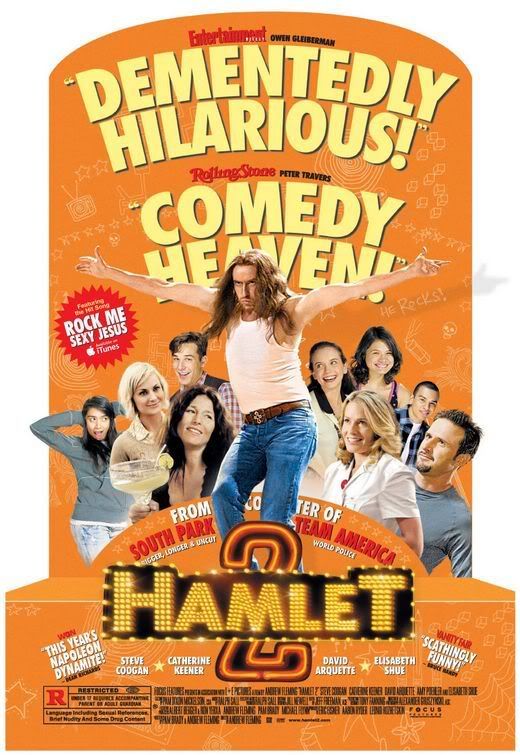
Hamlet 2


When I first read an article about "Hamlet 2" back in January when it premiered at the Sundance Film Festival I was instantly attracted to its title. A musical sequel to Hamlet? What fun! And then I read that Steve Coogan was the star, a British actor that I have enjoyed for a few years ever since I saw his short with Alfred Molina in "Coffee and Cigarettes." Both of these forces merged to form some kind of anticipation from me. Sadly "Hamlet 2" was not the comedy masterpiece that I had hoped for, but it is certainly an entertaining film, and a nice ending for the summer movie season. It also completes the quartet of R-rated comedies of "Step Brothers," "Pineapple Express," and "Tropic Thunder." I'm a bit pleased with Focus Features for giving it a moderately wide release (and failing, sadly), as it might give Coogan some kind of notice in America along with his memorably explosive appearance in "Tropic Thunder." 

Coogan plays Dana Marschz, a failed actor who worked in commercials for awful products ("I'm having a herpes outbreak. Right now. . .but you'd never know it. Thanks Herpicol!") After not getting work for a while he became a high school drama teacher is Tucson, Arizona, where dreams go to die. The drama elective isn't very popular, and every year Dana takes a popular movie and writes parts for his two "suck ups" Rand (whose sexuality is often called into question) and Epiphany. Every year the play is panned in the school paper by Noah Sapperstein, whose small size isn't a problem with Dana goes to him for advice. This year Dana learns two things. One, that many of the other electives have been cancelled, causing two dozen minorities to be forced to take drama. And two, that this is the final year of drama, as budget cuts are causing it to be cancelled. Noah tells the desperate Dana to put on the best play he possibly could, and Dana finished with Hamlet 2, a musical sequel to the Shakespeare play which is really a metaphor for his relationship with his father. Everyone basically agrees it is a terrible idea, especially since nearly every single major characters dies at the end of the original play.

In the play, Hamlet has a time machine which he uses, along with the help of Jesus Christ, to go back in time and save those he loves. But its the un-PC content within the story that end up causing the problems, and not the fact that Dana is touching what is considered to be the greatest play ever written. Its the fact that Jesus is considered to be a stud muffin who turns on all the girls (leading into the plays musical number "Rock Me Sexy, Jesus"). It's the fact that Satan is French kissing the President. And its the opening scene, where Hamlet, Jesus, and Hilary Clinton all come out of the time machine having some kind of a three way. This leads to the interference of Cricket Feldstein (Amy Poehler), who is hired to ensure that Hamlet 2 ends up getting performed, as the entire town is suddenly in an uproar over its content.

Steve Coogan is very funny as Dana, and he goes appropriately over the top in the role. His facial expressions and his excitement about acting and Hollywood that are impossible not to laugh at. Especially when he encounters Elisabeth Shue, who has quit acting and decided to take up nursing. And it also happens to be that Elisabeth Shue is Dana's favorite actress of all time. But it is clear that Coogan put an extreme amount of energy into the part, and it really does show. He carries the film for its first two thirds, and than the final act (which is pretty much the play itself) is quite funny unto itself strictly through concept. 

The first hour is loaded with flaws, many of which I was able to see past simply because the film was extremely entertaining. One of these is the mention of Dana's home life, and his marriage to Brie (Catherine Kenner) and them having a roommate, Gary (David Arquette.) Kenner is her usual caustic and witty self, but her character is somewhat not needed, sans for the scene where she leaves Dana-the films only foray into seriousness. It is this serious scene that ends up making the performance of Hamlet 2 more than a completely random and insane segment, and we can understand how troubled Dana was in the past. Arquette is completely useless, and he is actually given a role where he really doesn't need to do much other than just stand there in the corner and be silent. I did like the nabs the film made towards the inspirational teacher genre, which Dana is always trying to be, citing films like "Dead Poets Society" or "Mr. Holland's Opus." And how the tough kid in the class (Octavio, who for most of the film Dana thinks is named Heywood Kablowme) comes from a very intelligent family and has gained early acceptance to Brown. It's small moments of brilliance mildly scattered about the first hour that held the film together along with Coogan's performance. Not all the jokes here are winners, and at times it gets a bit to slapsticky for the material, but it does hold attention.

Also to note, the film does not only get better written as it moves along, with after the first fifty minutes it feels like its in the hands of a different director. In the first half we get quite a bit of short shots, framed with a single persons head in the shot, very much like a sitcom. It isn't until the play gets put into motion does director Andrew Fleming play around with tracking shots (for which there are quite a few during a choral version of "Maniac") and more trickier images. It just becomes a much better film as it moves along, although I wish the final scene had a more stronger punch (despite ending in the most sensible way I can imagine). But all in all, despite many imperfections "Hamlet 2" is an entertaining comedy, and hopefully will be a vehicle for Coogan to get more notice in the U.S. 

*** of ****

Tuesday, August 26, 2008

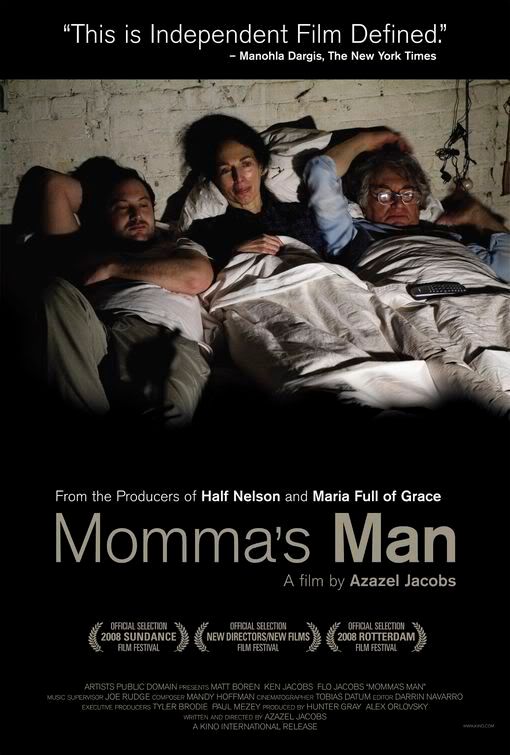
Momma's Man


"Momma's Man" is a realist "slice of life" film that I could not seem to care about or even want to. Celebrated for its very realistic portrait of family life, I found it overlong, underwritten, and it moves at a plodding and maddeningly slow pace. It features a lead performance by Matt Boren, who is on the screen for ninety five percent of the five, often times not even speaking a word. But if his Mikey was an interesting character, or had a look on his face aside from the rather clueless and lazy one that he has for the entire movie, I might have been able to find something interesting in the work. 

"Momma's Man" is the new film by Azazel Jacobs, who has two films prior to this one but is new to me. Jacobs casts his own two parents Ken and Flo Jacobs as the parents in the movie, which some will say is a bold and interesting move. I just have the feeling that he did it so that many will claim it was a bold and interesting move, in the similar way many celebrated Andrew Wagner for casting his own family in the rather awful "The Talent Given Us." In both cases we do a realistic feel, but are forced to watch some terrible acting and awkwardness from two sets of non-actors who act as if the camera is right in front of them.

The film has a very loose plot, where Mikey is visiting his parents (unnamed aside from Dad and Mom in the credits) while in town for work. When he has problems with his plane he decides to stay for an extra night, but then he just decides not to leave. He goes to visit a friend of his from his childhood. He sets up a meeting with an ex-girlfriend who he wrote a song about when she sent him a hate letter. (where "Fuck You" is said a lot). He goes through boxes from high school and finds notebooks filled with poems that he once wrote. He calls up his wife, Laura, who is at home with their little daughter. As the weeks pass she gets more and more worried, wondering if her husband is ever going to come home. And his parents get worried to, trying to figure out what is wrong with Mikey and if he is ever going to leave.

There really is not much going on in "Momma's Man" despite Jacobs trying to tell us there is. Mikey is simply not an interesting character, and I felt no intensity at all about if he was going to leave or not. I was reminded of another realist film of this summer "Take Out," which came out in June. That film spent nearly an hour having our Chinese delivery man lead character going from deliver to delivery collecting money so that he could pay his smuggling debt. That film barely had a script, but it was the intensity of the situation, and the constantly engaging lead performance that made it realistic and made it interesting. Matt Boren's dull interpretation of Mikey is frustrating, and not in the way that Jacobs would want it to be. His parents are not actors, which was probably the point, but after a while Flo Jacobs constantly asking Mikey if he wanted food or tea was just grating and the result of a poorly conceived script. After a while the script focuses on Laura at home, getting help from a neighbor. Instead of having those scenes feel intense by having us want Mikey to go back home before his wife leaves him, it just feels like filler, to spread out this plotless film to some kind of feature length (and at only ninety minutes this film feels much much longer.)

Perhaps I am in the minority here (and based on other reviews I've read for this film I feel like I am), but "Momma's Man" is a grating and terribly paced "slice of life" movie. It fails on all accounts, and while some have been moved by the material here, I just found it irritating and painfully slow. For a similar "portrait" feel, I still have to recommend "Take Out," which was also underwritten, but had enough talent involved inside the direction and acting (and its barely acting in that case) to make up for the lack of script. "Momma's Man" is just a slow and bothersome piece of work.

*1/2 of ****

Wednesday, August 20, 2008

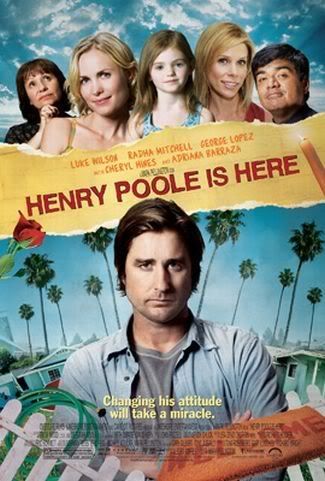
Henry Poole Is Here


In order to get something out of "Henry Poole Is Here," one would be forced to have a certain suspension of belief. After all, this is a film all about the power to belief-to belief in faith, miracles, and even God. Unlike other "faith" based films-such as last year's awful "The Ultimate Gift"-"Henry Poole Is Here" does not try to jam down a message of God down the audiences throat, which makes it possible for people of all different beliefs to be touched by it. That choice by the screenwriter, as well as the very humanistic performances by the entire cast, made this film extremely touching, and a very rewarding experience for me. 


The first time we meet Henry Poole (Luke Wilson) he is clearly in bad shape. Unshaven and sporting worn out and untucked button down shirts, Henry buys a rather beat up house in the neighborhood he grew up in, and decides to spend his days wallowing and drinking bottle after bottle of vodka. Henry was recently informed by his doctor that he has a terminal illness, and all he wants is to be left alone. However, he is instantly bothered by his neighbor Esperanza (Adriana Barraza), who believes that the face of God is on Henry's wall. Henry just thinks that it is a watermark left over by a bad stucco job. However Esperanza spreads the news and soon enough there is a line of people gathered outside of Henry's house trying to get a look at the face of Christ. Meanwhile, Henry gets involved with Dawn (Radha Mitchell), the single mother next door whose daughter Millie is mostly silent. Its with Dawn's help that Henry is able to believe in life again.


RIght off the bat, Luke Wilson is excellent here. After a large bunch of silly and lazy roles like in "My Super Ex-Girlfriend," "Mini's First Time," and "You Kill Me," he is finally given a real depth filled character to sink his teeth into. Clearly depressed, Wilson is able to do quite a bit with his appearance, and his eyes are so filled with hurt, pain, and fear throughout. He is aided by Adriana Barraza, who is given a nice balance of emotion and comedy much different from her riveting role in "Babel." Radha Mitchell's performance as Dawn was also quite satisfying, despite the fact that her love story subject with Henry was an easy route for the screenplay to go. 


I am also somewhat crazy about several of director Mark Pellington's choices behind the camera, especially in the films first half. Pellington does something with sound and atmosphere in these opening scenes that I have a hard time explaining. I felt the same way about moments in Ridley Scott's masterpiece "Matchstick Men," where there is some trance like moments involving background sounds-such as a train whistle, or a wind chime. They really come together to form a look into Henry's very damaged and angry mind. The music score by John Frizzell is quite wonderful to, with a very nice mixture of quirky and beautiful, reminding me a little bit of something Thomas Newman would do.


However some choices in the second half of the film I must admit I was not crazy about. I suppose it was the love story between Henry and Dawn which, while sweet, just seemed a bit obvious and not the way I wanted the story to go. It leads to a somewhat over long movie, where Pellington has several music video type montages with Henry running, or Henry watching the sunset, or Henry playing with Millie, which padded the running time. However Wilson is able to stand firm and in character, and all of the actors really continued to bring me back to reality.


As I said, it is important to suspend belief in the movie, which ends up being quite easy as all these actors make it very easy to believe what is happening here. The screenplay really handles belief and faith in a very gentle way, never having the viewer feel superior to those that fall for the face in Henry's wall. And I found it very clever having the image on the wall seem stronger and stronger as the film moved forward-during its first appearance it barely resembles a face compared to what it looks like in the films climatic moments. This a film that does have the power to move, and I think it can move even the strictest atheist. Simply because it does not focus on a belief in God, but just a belief in life and love, and in not giving up whenever things seem rough. It's quite uplifting in a month of somewhat cynical and mean spirited films.


*** of ****

Saturday, August 09, 2008

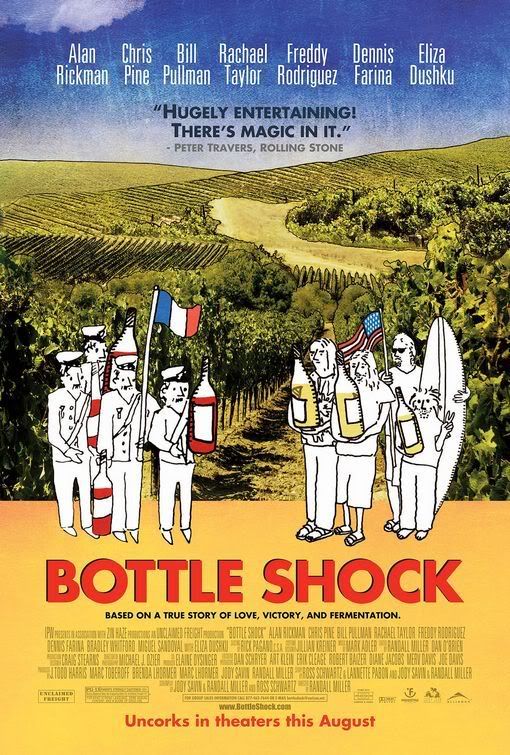
Bottle Shock


"Bottle Shock" is the new film by Randall Miller, a director whose work I've admired over the last two years. With three films under his belt, I first noticed him in 2006 with "Marilyn Hotchkiss' Ballroom Dancing and Charm School," a sometimes overly sapping romantic comedy, but one directed quite well and with some beautifully dark cinematography. The same went for his second film "Nobel Son," which I saw at the Tribeca Film Festival last year and is being released in October. Done with a very different tone and feel from his first film, it was still quite noticeable what talent that Miller had. Shot around the same time as "Nobel Son" and gathering quite a number of actors from that film, Miller made "Bottle Shock," a unsurprisingly entertaining historical piece with Alan Rickman giving a terrific lead performance as wine snob Steven Spurrier, who in 1976 shattered the myth that the French have the most superior wine in all the world. Not since the 2004 masterpiece "Sideways" have I seen such an wonderful film about wine. While "Bottle Shock" may not be as perfect as "Sideways," it certainly does have more information about the craze of wine, and the passion behind blind wine tastings. 

In '76 Spurrier was living in France, owning his own little empty wine shop, trading snobbish stories with his American friend Maurice (Dennis Farina). Steven decides to go to California to find some competition in a contest where he collides French wine and American. His visit to California has him getting involved with a various group of people. At the head is Jim Barrett (Bill Pullman), whose opinions on the snobby Steven are instantly formed when he helps him change a flat tire. Jim quit his job a while back to open the winery, and he tries to perfect his white wine. However he doesn't get much help from his somewhat slacker son Bo Barrett, who is consistently late and comes to work drunk or on the cusp of a one night stand. There is also Gustavo, a Mexican worker who is secretly creating his own brand of wine on the side. And lastly is the new intern Sam whose good looks cause a jealous strife between the two male friends. And alongside all of this is Steven, collecting wine from the various villages to bring back to France to destroy this myth once and for all.

As with all 'based on a true story' films, there is probably much fiction actually being conveyed to us. The primary one would be the love triangle between Bo, Gustavo, and Sam, which was an added subplot that I had the most problems with. It burdens the film down with this slow and contrived love story, which does not even offer a tied up conclusion with the man that she does not end up with. It was a love triangle created simply for dramatic purposes, and it weighs the movie down. The film really succeeds mostly when Alan Rickman is on the screen, and as Steve Spurrier he commands the audience to watch him. Rickman is terrific at delivering long and drooling speeches, and he does it here in both English and French. And him and Bill Pullman, who have an odd buddy relationship here, play off well and have great chemistry together. Pullman's performance does deserve more script than he gets, and he should have gotten a more solid arc and some back story. I would have liked to see more with these two characters instead of the convenient love story that we are stuck with, and more screenplay could have been written to give us back stories involving the Pullman and Rickman characters, who are the ones that are the most palatable to spend time with. 

Despite that bit that bogs the movie down, "Bottle Shock" is a crowd pleaser tried and true. It may be obvious how the film will end once the main characters present themselves, but its the journey that makes it worthwhile. It's the intensity of making it to that final revelation-during the wine tasting contest itself-that makes Miller such an enjoyable storyteller. And his direction is really quite unique, offering us some rather contrived story lines and genres, but never giving us any conventional camera angles or directorial approaches. Take a shot of Rickman driving-instead of giving us a typical close up of him driving, we get a rather obscure camera angle, as if you camera was by the break pedal. Or a shot of him trying to change a tire is giving more energy by making it a high angle, giving us a beautiful view of the blue sky and green trees of California. 

Miller really has a knack for the moving image, and I really do get quite enjoyment out of his movies. They are never perfect, and at times feel bogged down by contrived plots, but at the same time there is an undeniable charm about them. Perhaps its their look, or their performances, or just characters that are such a perfect blend of the real and the fantastic, that make me want to see what Miller will direct next. "Bottle Shock" is not a perfect film, not at all, but its warm and even oddly magical. By its end it gave me good vibes. To compare it to another wine film, "Sideways," I will admit it does not come close to even touching the masterful film making of that film, but its a nice smaller companion piece to the love people have of wine and how life consuming the cultivation of the grape could be to some folks. And if Randall Miller could make a film that I am able to compare to another which had a strong impact on me, he's on the right track.

*** of ****

Thursday, July 31, 2008

Films to Looks for in NYC

A few films I've seen already to note have been released in New York City that I'd like to bring attention to.

The first is the Duplass Brothers excellent "Baghead," which I saw at the Tribeca Film Festival a few months ago. Billed as a horror comedy, this is more of a relationship comedy, and is more proof that the Duplass Brothers (and actress Greta Gerwig) are the only two worthy things in this so called "mumblecore" film making movement-but then again, I don't really count the Duplass' as mumblecore film makers.

Here's the review for the film.
-----
Also out is the entertaining documentary "Man on Wire," about Phillipe Petite, who decided to string a wire between the two towers of the World Trade Center and balance on them. Here is what I wrote on it after seeing it at Sundance at BAM last May.

""Man on Wire" is a consistently entertaining and even fascinating documentary which won a few prizes at the Sundance Festival earlier in the year. It's one of those stories that comes along every once in a while that really does just show that the best stories cannot be made up. And much like the main subject of "Grizzly Man," or "Deep Water," "Man on Wire" has such a fascinating main character-in this case we follow Philippe Petit, a tightrope walker who, in the 70's, attached a wire across the two World Trade Center towers and walked back and forth a few times, eventually getting arrested. Doing a mix of interviews with the actually people involved in the incident, and a reenactment, Marsh crafts a very entertaining and thoughtful story, which is even also quite intense. Although I will admit that I would have liked some more after the incident-it even hints at how Petit changed after the event and after he started getting famous, but it doesn't explore that. And I would have been curious how Petit would have felt after 9/11 occurred, with the towers being a different kind of symbol than it was for others."
-----------------------
Lastly being released on Friday is "Frozen River," the next one in the endless list of films about illegal immigrant smuggling that I've seen in the last few months. Headed by a terrific performance by Melissa Leo, "Frozen River" is a tense and powerful drama, about a woman who resorts to nearly anything to provide for her family. I don't have any material written on "Frozen River" to direct you to, but I can recommend it.
----------------
Also been released in New York is the awful "American Teen," which I was surprised at the somewhat low box office take for its first release-I was certain it would have been a big hit that I would have declared overrated for years to come. But several other critics were able to see past this cliche ridden documentary that had many obviously staged moments and situations. Here's what I wrote about it when I saw it in May.

Sunday, July 27, 2008

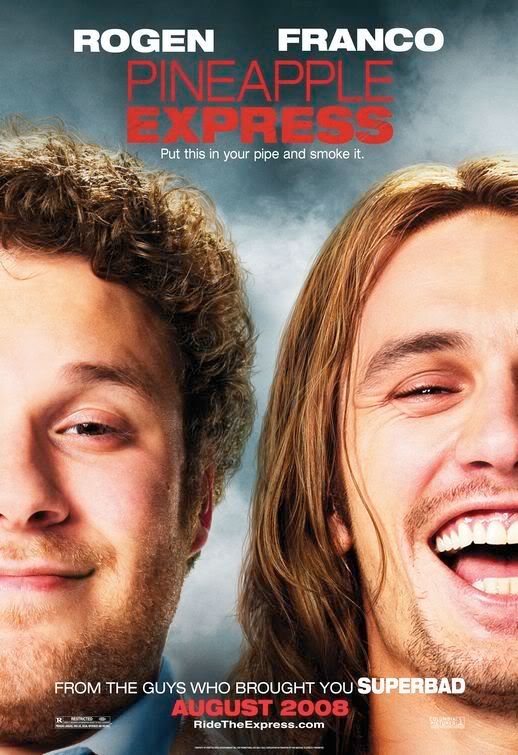
Pineapple Express


Earlier this year I saw a film named "Snow Angels," which I found hauntingly perfect in every way. At the moment its one of the best movies of the year, and will certainly remain on my list when 2009 rolls along. The film was directed by David Gordon Green, whose filmography contains a number of independent, low-budget dramas, so it would seem a bit of an odd choice for him to direct "Pineapple Express"- a big budget, action comedy in the vein of the R-rated comedies of the decade like "Superbad" and "The 40-Year Old Virgin." So with that in mind, this is a bit of a different genre for him, but at the same time its also something a little different for Seth Rogen, whose venturing into a major genre cross. But the final result ends up being something quite hysterical and simply a grand time out.

Rogen plays Dale Denton, a process server who in his spare time smokes massive amount of pot. Not really doing much with his life in terms of taking care of himself, Dale even dates a high school senior and is jealous of the jocks who seem to hit on her on a daily basis. His dealer Saul Silver (James Franco, once again playing a character I've never seen him do) gives him a bit of a weed called 'pineapple express,' the grandfather of marijuana. All is good and fine, but when Dale spots the local drug dealing godfather and a police officer shooting his Asian rival, Dale and Saul are suddenly being hunted by some bad people. Along the way they are aided by Saul's middle man Red (Danny McBride, who was given such a boost from these guys after they loved "The Foot Fist Way"), who sometimes works for them and sometimes against, depending on whose pointing the gun.

"Pineapple Express" is a very different vehicle for Rogen, Apatow, and the gang, just in terms of the genre crossing. We know that Seth Rogen writes some great comedy, but is it possible that there could be some great and funny action in here as well? Its proven quite early on with an extended car chase, and sealed even later during a huge set piece in a shipping barn. Rogen and Franco have great chemistry as well, giving us a very strong buddy element as well. Rogen does his thing well, but its Franco whose the real revelation here. After playing a rather stale straight man in the "Spider-Man" films, Saul is a role that Franco could really sink his teeth into, and its clear that he is having a fun time playing him. With his long hair, his 70's drug dealing clothes, and his yellow head band (which I learned was added to the wardrobe after James Franco cut his head during a stunt scene), its even funny to just look at him. Danny McBride is really just doing a rehash of his somewhat irritably likable character in 'The Foot Fist Way," and is good at providing a balance between the two so that he isn't intolerable. And the last performer to note is Craig Robinson, of "The Office" fame, who provides very strong laughs as one of the men after the two, certainly stealing that subplot of the film.

The film is absurd and ridiculous, but that really ends up being its charm. Built under the concept of "what if the lead characters in these action films where just high the entire time?" its quite obvious that at its core this is just a satire of action films. While not as smart as the similarly executed "Hot Fuzz," there are some very memorable characters, jokes, and action sequences here. I was actually quite surprised at the amount of violence here, and they cross the line several times (for example, when one of the characters shoots the foot off of a character already dead.) However the finale, however over the top and insane, is really constantly entertaining and enjoyable. There is a rather nice buddy relationship between the two main characters, but a very strong difference between this and "40-Year Old Virgin," "Superbad," or "Forgetting Sarah Marshall," is the lack of the unexpected depth and heart out of the characters. This isn't a negative thing, but this is the first time an Apatow produced comedy goes over the top and actually is successful doing it, unlike the awful "Drillbit Taylor" or "You Don't Mess with the Zohan." As expected, there is a fair share of improv here, mostly the final scene which has Saul, Dale, and Red sitting in a diner discussing their adventures. At nearly three minutes in length they do a quick recap of nearly the entire movie, done in a way that doesn't feel like a waste of time, but like comedic genius. 

Not all of the comedy works of course. The opening scene, set in the 1930's, shows experimentation with various forms of weed. The scene is shot in black and white and given a B-movie feel (the Columbia Pictures logo is even in black and white), but the scene really serves no other purpose than to give Bill Hader something to do in the film. It wasn't a very good opener, and didn't set the bar very high for the rest of the movie. Another scene that doesn't really seem to work is a very long fight scene in Red's apartment between the three leads, which eventually overstays its welcome and isn't a very good introduction to the Red character. It's small quips here and there that can't make "Pineapple Express" perfect, but in the stoner genre, many people will be massively content with the finished product.

And lastly, how is David Gordon Green's direction? Tackling such a different genre and jumping into the mainstream at the same time is a bold move, but Green segways very well. It's somewhat hard to believe that the director of his film could have once directed such a powerful and realistic drama like "George Washington," but it even has his same style and feel. This isn't nearly the masterpiece that "Snow Angels" was (however much I'm in the minority of that), but it proves that he does have range and can jump into this strong comedy and be successful. 

"Pineapple Express" opens August 6th everywhere.

***1/2 of ****

Sunday, July 20, 2008

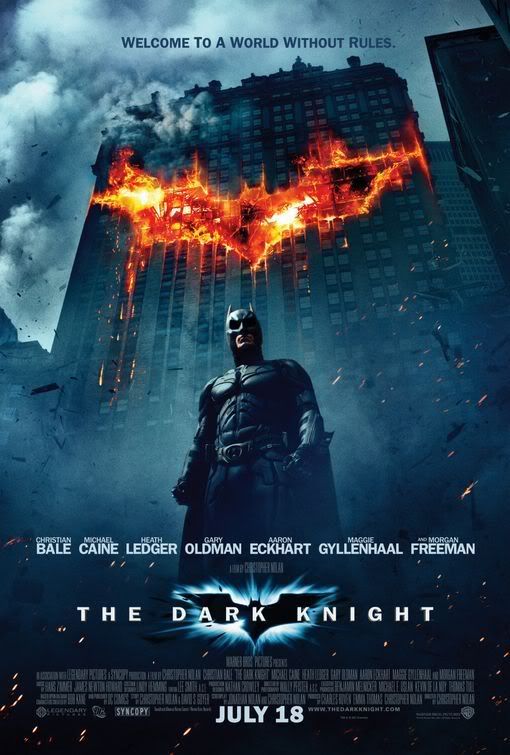
The Dark Knight


I really did not have many expectations for "The Dark Knight," despite finding the trailer somewhat good. I honestly was not a fan of "Batman Begins," even though there was so much love and affection for it, with critics and Batman fans alike both proclaiming it the Batman movie to end all Batman movies. Rewatching it in preparation for "The Dark Knight" still had me wondering what the big deal was. After seeing this sequel, I have put more faith in Christopher Nolan's "Batman" vision, and he somehow magically fixed all of the problems that I had with his first film. "The Dark Knight" is an excellent super-hero movie, which works beyond the realm of the super-hero genre and into the realm of a great crime film. There are not many large set pieces in this film, and Batman only appears for a small handful of time, but its the drama that elevates this film-much like the drama elevated "Spider-Man 2," only this is bigger and better and almost flawless in execution. 

The film starts off right where 'Begins" left, only Batman isn't leaving the type of impact that he expected. People are still somewhat doubting him in Gotham, and he has brought out a bunch of copycat vigilantes-the difference being that they kill the bad guys, breaking Batman's primal rule. Our bad guy here is The Joker, played by the late Heath Ledger, who approaches mob bosses telling them that he'll kill the Batman if they give him half of their money. The mob men have become scared of the Batman, meeting in daylight to avoid coming into contact with him. Meanwhile Bruce Wayne/Batman begins to see hope in retiring in the form of Harvey Dent, the Distract Attorney of Gotham (played by Aaron Eckhart) who is known as the White Knight of Gotham. Dent has an agenda to destroy the crime spree and save Gotham, but he also happens to be dating Rachel Dawes, Bruce's childhood love (this time around played by Maggie Gyllenhaal, taking over for Katie Holmes who had to decline this because she wanted to film "Mad Money.") 

There are several plot twists here and there, the biggest one really being the fate of Harvey Dent (but those that know even a small bit about the Batman story will know that Dent ends up becoming Two-Face.) As mentioned, all of my problems with "Batman Begins" were remedied here. To begin with, Nolan was able to find a better actress than Katie Holmes to play the love interest. While I'm still not on the edge of my seat with them getting together (as I was with the love story in "Spider-Man") Gyllenhaal is much more competent of an actress than Holmes (although I'm still not her biggest fan either.) The Joker (and even Two-Face) are far more interesting bad guys than The Scarecrow ever will be. And the action sequences here actually were visible. One of my biggest qualms with "Batman Begins" was that I couldn't see anything-Nolan had an edit nearly every second during them, and the picture was so black it was nearly impossible to make anything out. Here Nolan allows the camera to stick around for a bit, and also gives us enough light to really make out what is happening. Darkness is used at really pivotal times, such as to cover up the deformed side of Two-Face, or to really show The Joker at his most fiendish (although he does stick out like a sore thumb with that white make-up.) And the action set pieces (few and somewhat far between) are really a wonder to behold, especially a car chase scene which uses very little CGI. 

Nearly all the lead acting is perfection. Bale makes a terrific Bruce Wayne, although sometimes the booming Batman voice seems a bit forced through. Ledger (whose been getting Oscar buzz since his death in January) is gleefully insane, and an extremely memorable villain-giving us a nice balance of dark comedy and insane madness. He doesn't steal the show, as there is good work by everybody involved. Eckhart is tragically powerful during the emotional parts of Dent's story. And the rest of the high profile cast-Michael Caine, Morgan Freeman, and Gary Oldman-all get their moment to shine. When "Batman Begins" was released, Christian Bale really wasn't much of an A-Lister, so they surrounded him with vet actors.  This is fine, but their work in "Batman Begins" really did seem like it was just there to give the film a boost. But all of them get their little moment here, especially Oldman, whose Gordon really gets a few applause worthy moments. The film is packed with events and characters, but it never seems overloaded with them, which was the case with the flawed, but entertaining, "Spider-Man 3."

What does end up change "The Dark Knight" from any other super-hero film was its realism. It doesn't go the over the top route as the other Batman films (which isn't a negative, this is just a different approach). It is dark and dramatic-the Joker's origins aren't explained by some kind of toxic accident like we were told in the other Batman film. Instead we are left to always wonder what made The Joker who he is-and his origin story about his scars which he says from time to time is always different. Ledger is actually doing a sick criminal, whose theories about chaos are grimly fascinating. It makes me mad when I read reviews that suddenly compare Ledger's performance to Jack Nicolson's by badmouthing the Nicolson one. They are two completely different approaches to the story-even Nolan's vision of the film is different from the Burton one. There is no need to suddenly act negative towards those early two films, which just looks at the Batman action in a different way-which is through extreme camp instead of it being an intense crime drama. This is not the smooth Point A to Point B type of super-hero tale that we've seen before-there is true and genuine chaos here, and there are moments where I really did not know what would be the fate of these characters, all the way to the very end which takes a very impressive and dark turn. 

So its with extreme happiness that I am able to be so happy about "The Dark Knight" because of my reluctance with Nolan's first film. It is epic in the highest sense of the word, so vast in scope, character, and drama. Nolan seemed to know what he did wrong and fixes everything to the utmost amount of perfection. And the ending, which does set us up for a third film and I hope that we are treated to it if he can possible pick up from the brilliant (and downbeat) final five minutes that we are treated to here. I got chills as I watched each of these main character walk out of the film. "The Dark Knight" is the best film made about a super-hero that I've seen, which uses the crime drama genre to elevate the material away from any formula or paint by numbers plot revelations. This is a great step up for Nolan, and its one of the best movies I've seen this year. 

Final Rating-
**** of ****

Portions of this review can be found at this address.

This review can also be found here.

Wednesday, July 16, 2008

The Stone Angel

The titular angel in Kari Skogland's "The Stone Angel" refers to two things: one is an actual stone angel used atop the family plot of the Currie family, and the second is Hagar Currie herself, one of the strongest female protagonists in quite some time-played with fierce brilliance by both Ellen Burstyn in her golden years, and newcomer Christine Horne in her early ones. An occasionally over-heavy, yet well acted, drama, "The Stone Angel" premiered at the Toronto Film Festival last September-and while at the festival I heard absolutely nothing negative or positive about it, which was surprising considering how fast word travels there. I had honestly forgotten that it even existed until the trailer revealed that it was a part of the festival's selection. I give credit to its release to Ellen Page, whose "Juno" success suddenly caused every one of her already existing pre-"Juno" indie films to be released, however awful (such as "The Tracey Fragments.") It's probably irony that Page isn't in this film very much, appearing in a few scenes towards the end, despite getting second billing in the trailer and quite a bit of space on the films poster.

Starting in the present, we meet Hagar Currie on her way to tour an assisted living facility with her son Marvin (Dylan Baker) and his wife Doris. From her very first line ("I have to go to the bathroom!") one can tell the fierce independence that she has, just in Burstyn's delivery. It's revealed in these early scenes that she is somewhat unstable, suffers fainting spells, and is often forgetful, but she resists going to the home. Through flashbacks a la last year's "Evening" (a film that I can easily compare this one too), we get a sense of who she was and is, showing us her separation from her father when she decides to marry Bram Shipley (Cole Hauser). Her father would rather her continue the family business of running a store. We see her relationships with her two sons-Marvin and John-and as she gets on in the years we see her make many mistakes, not even getting it fully right when she is close to death, making her more human than any movie character you'll see all year.

Burstyn is extremely good in this film, and this is her most mature role in a while (fresh off of "The Wicker Man" from two years ago). But the real soul of the film comes from young Christine Horne, who plays the young Hagar, does not only resemble and act like Burstyn would, but also acts with such experience that its hard to believe this was her first major role. A supporting role by character actor Dylan Baker is also very welcome-Baker is one those actors who appears in and out of many movies and whose name never sticks, but in one week he showed much range for me, making me laugh hard in 'Diminished Capacity" and almost breaking my heart here. And Ellen Page, however brief her performance, is good in the last performance from her pre-"Juno" burst of fame. Playing at interesting parellel to the Hagar character, Page's Arlene is a chance for Hagar to stop someone else from making the same mistakes that she did. Page does a good job at resisting Hagar's advice, just as Hagar did when everyone tried to advise her. Comparing this more human performance to "Juno," or even the film she made after that "Smart People," I personally think that "Juno" might have been the worst thing for her in terms of future typecast. Similar to Jon Heder never breaking the "Napolean Dynamite" image.

It really ends up being the acting that makes "The Stone Angel" easy to recommend. At times the screenplay does get a bit convoluted in terms of drama-eventually so much stuff happens to these characters that it got tedious and even a bit unbelievable, but thankfully the performances played it well enough where it did not become overbearing. And the only example I can possibly think of, a moment of real true beauty here, comes towards the end of the film. Hagar (in this case played by Burstyn) goes to see Bram after many many years of separation. We see what he has become-a sad and lonely drunk who needs whiskey instead of medicine-and the two of them share a look. A simple glance, that is acted so well where we can see their histories and their love and her ability to never give up on him, that almost brought a tear in my eye. Sadly the whole film couldn't deliver that kind of simple beauty, but its the moments like those, played so effortlessly by masters young and old, that made "The Stone Angel" worthwhile.

Final Rating:
*** of ****

This review can also be found here.

Monday, July 07, 2008

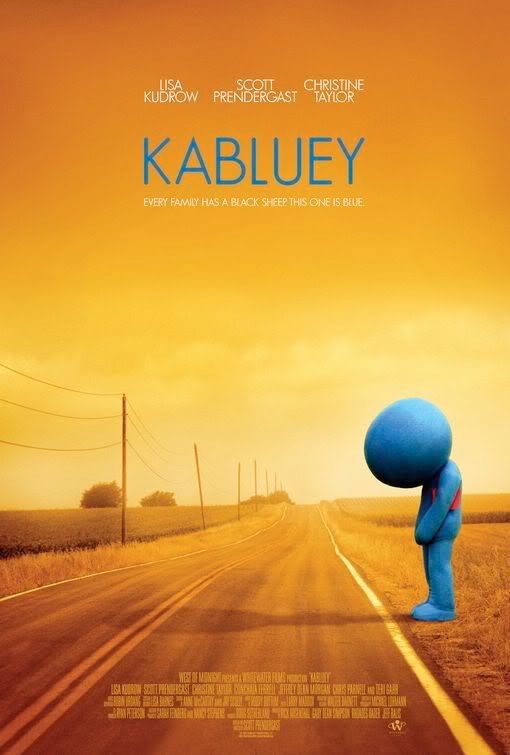
Kabluey


Scott Prendergast's "Kabluey" is one of those little movies that warm the heart when they get a theatrical release, and when that theatrical release actually gets some revenue, however moderate. It's also the first bone budget indie film I've seen in a while that thankfully doesn't involve some kind of coming of age road trip-which is somewhat ironic as the center piece of the film involves a road. "Kabluey" is a short, sweet, and ultimately quite hilarious little movie, which is smart enough to avoid a political message that would weigh haved weighed it down even though the device that sets in motion the entire plot. 


Lisa Kudrow stars as Leslie Miniver (perhaps a sly reference to the war torn family in "Mrs. Miniver," but that could be reading into it more than it should be), whose husband Noah (never seen except in pictures where he constantly has this snarl on his face) has been sent to Iraq for his tour of duty. Left at home with her two screaming and misbehaved children Cameron and Lincoln, Leslie is in desperate need to help. Her mother in law than comes up with the idea of sending her son Salman (played by director/writer Prendergast) to babysit for a while. Salman is down on his luck in every way possible, to the point where he tries to sell his car for two hundred dollars just to try and get a few meals. He does come willingly, and after a few days of being tortured, is given a job at Leslie's company BluNexon. Hurt in a stock market crash, the company is in a large building with a lot of office space, and Salman's job is to stand on the side of a highway road passing out fliers to rent the office space. The only catch is that he has to wear a large blue suit-the emblem of the company that isn't really much of anything-just a large blue blob. 


"Kabluey" is very thin on plot, which ends up being a positive more than a negative., despite getting minorly tedious towards the end. It's less of a plot than just a bunch of short sketches, tied together by a loose story. The furtherest it goes is giving Leslie an affair with her boss, which Salman tries to stop quickly to defend his brother. But Prendergast does have a gift for offbeat physical comedy. Researching him after seeing the film, I only recognized one title. A four minute short film that he did a few years ago called "Anna Is Being Stalked," which I remember seeing on the IFC Channel during a shorts presentation. That short you can find online through google, and I'm pleased that he was successful with his first feature. The blue suit, which could have been only used for comedy because of the way it looks, is made much funnier by what he does inside of the suit-which include having to stick his hand out of the rear to get food and drink inside as the suit doesn't have a place for his hands. 


The material here is sometimes overly quirky, a problem that I have with several independent movies, and I'm sure some of the material must have looked odd on the page. But its the performers that really elevate the material quite a bit, giving it the humanity and the realism that this sometimes extreme quirk really needs. I was mainly impressed with Lisa Kudrow, and this is her best post-"Friends" work since "Happy Endings," (although she hasn't really been given many parts, unless you want to include "Marci X.") There is also fun supporting work by character actress Conchata Ferrell and Teri Garr. The latter does her second performance in under a month (the other being "Expired) and in both cases she is given a character that deserves more time because of how well Garr plays it. Here, Garr plays a woman who screams in anger and terror every time she sees Salman in the suit because she lost her life savings when the company crashed. Not much is really done with her character, and the screenplay wraps her character up after an encounter in a grocery store. The flawed screenplay does this several times-introducing some very good ideas and than dropping them in favor of a very brisk 80 minute running time. In one segment, Salman gets a job in the suit at a kid's birthday party, and eavesdrops on the other guest who just ignore his presence not deeming him a threat. And the viewer only gets a single joke out of that which doesn't even end up being as funny as it should have been.


Despite its flaws, "Kabluey" ends up being a very effective little comedy, which is blessed with several memorable performances. Even side characters are given enough to care about, and they deliver some truly hilarious moments. I wish some of the material could have been fleshed out a bit more, but for a feature debut Scott Presdergast really does offer up hope for a follow up. 


*** of ****

Thursday, July 03, 2008

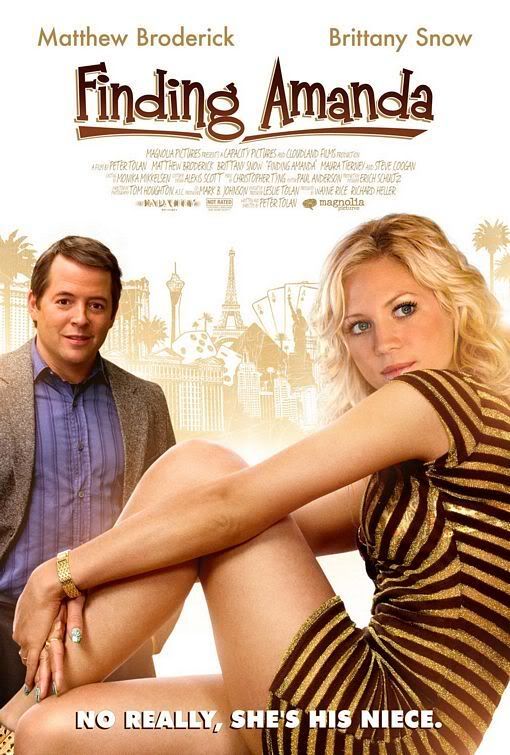
Finding Amanda


"Finding Amanda" is a dark comedy about gambling, drinking, strippers, hookers-you name it. Really bottom of the barrel stuff in terms of dark humor. And yet there wasn't a single moment throughout its rather smart screenplay-filled with some four letter words and few sexually explicit conversations-where I felt dirty watching it, or felt like it was dirty for the sake of being dirty, or it was trying to cross a line to be edgy. Everything really seemed in place and earned in a way, enough for the third act to be fittingly poignant and even somewhat sweet. Matthew Broderick is one of those actors-much like John Cusack-who the audience just has a tendency to want to root for him and want him to win. Take Cusack in "The Ice Harvest," a film where he lies and cheats and steals, and yet in the end he still looks like a good guy. The same goes for Broderick's Taylor Peters, a TV writer who is finally getting his recognition back on a somewhat low rated sitcom starring Ed Begley Jr. Taylor had a few rough years where he was addicted to drugs and booze, but is starting to get on his feet with the help of his wife Lorraine (played by Maurs Tierny.) However Taylor can't seem to stop gambling, and will easily throw a few thousand dollars at the track.

When his wife is ready to leave him because the gambling is getting out of hand, Taylor decides to try and show her that he can control it. And the perfect opportunity arrives when he learns that his twenty year old niece Amanda (played by Brittany Snow) is working as a hooker in Las Vegas. He vows to go to Vegas, find Amanda, bring her to a rehab center in Malibu, and not gamble a single cent while being there-a rule that he breaks almost the second he makes it to Vegas.

Broderick really does give a silently terrific performance here, really making us interested in this character from the first second he appears on screen. He turns this somewhat seedy and sick man into someone to care about, and I was absorbed in all of the aspects of his character-from all of the lies he tells all the way up to the somewhat poignant truths that he delivers in the films final scenes. Brittany Snow also does a good job as Amanda-a young girl filled with hope and love and really living a life that she doesn't deserve, and yet she and her uncle share so many of the same painful life choices, and both of them play this relationship aspect of the film so perfectly. Both also deliver some of the real crisp dialogue-written by director Peter Tolan-well, offering some real laugh out loud moments. Many of which also come from a casino worker played by Steve Coogan, one of those guys that tries to be everyones best friend when he really doesn't give a damn.

And than the ending, which really doesn't provide full closure for either Taylor or Amanda, really is quite fitting and effective. I don't want to ruin anything, but it really does provide a fitting conclusion to the relationship aspect of the film, which really ends up being the most important-how Taylor and Amanda end up helping each other find happiness and contentment-an irony considering how they both have made so many bad choices in their lives. This is a point driven home by a short monologue Broderick delivers towards the end.

Sadly "Finding Amanda" did not find any kind of real audience when it was released last week, and I saw it to late in its one week in theatres to really try and recommend it as much as possible. But that is why they invented DVD, and this one is coming out in the middle of September. It really is a well scripted and well acted dark comedy, delivering some moments of edgy humor, but never to a degree where it gets excessive or feels un-needed. In this world of somewhat seedy activities, the language really does fit. It's a good film, and one of the more refreshing offerings of the year so far.

Final Rating:
*** of ****

Monday, June 23, 2008

Celine and Julie Go Boating

Its been almost two weeks ago since I went to a screening of "Celine and Julie Go Boating," and I wish I did a write up on it while it was still playing at BAM. It was only recently that I read up on the film and learned that it is not out on any DVD format for people to see, and the theatre screening was actually somewhat rare. In any case, it did take me some time to really process this somewhat massive film-a real life fantasy story of almost the most innocent kind, which also happens to be a bit over three hours long, something which I found interesting with a film like this. It's an epic in the smallest sense, almost, and I wish I would have the chance to see it again quickly, to somehow process it all again. I think I like the film the more I think about it.

In a nutshell, the film revolves around the meeting between Celine and Julie. The two somehow stick when Julie (reading a book on magic in a park) begins to follow Celine (a magician) after she drops a scarf while running down the road (this being a scene taken from the first scene of "Alice in Wonderland" which this film is loosely based on.) Eventually the two of them become somewhat inseparable, and eventually begin to retreat into a fantasy world where they watch a melodramatic murder mystery unfold-with the aid of hard candies that the would get from a rather mysterious house. Eventually the two of them feel the need to interfere with the story to save a little girl from getting killed.

At such a massive length, one would suspect they would get bored of the movie, especially with a somewhat simple plot such as is. But you would be surprised how involved and how easily you fall into the "antics" of these two women-played by Juliet Berto (Celine) and Dominique Labourier (Julie), who depict such quirky and wonderful chemistry. The facial expressions and the banter between the two is adorable, while the laughing fits they burst into from time to time are contagious, especially in the final act when the two cannot control their happiness and delight at being placed into the story that they have been watching for many many nights. The fairy tale elements of the movie end up working mostly through their performances, and much like the ridiculous plot twists in 'Lady in the Water" end up working because you buy into them so easily thanks to the large talent revolving around the screenplay.

Practically every element of the film provides hopeful sentiment that make the movie such a joyous and quick experience-sans the murder subplot, which since its of a little girl probably isn't very joyous. What strikes as the most happy would probably be how Celine and Julie share the same type of imagination-and even though the fantasy world they concoct is only part of their own head, they manage to find a middle ground between their two imaginations so it is like they are the same person. It's like little children-how they play in worlds that somehow interact with one another, but slowly into adulthood that common imagined bond drifts away. And yet Celine and Julie manage to find that bond within one another-and once again due to the wonderful performances by the two actresses, it is easy to buy into that little kid notion. I wish I could see the film again and try to find more correlations between the real world and the fantasy world, to see if there are any clues within their surroundings that key into the major events of the fantasy, but alas I doubt I'll see the film for a while (unless Criterion manages to make some kind of edition, this seems right up their alley).

I return once again to the very first scene-where Julie chases Celine after witnessing her dropping a scarf. The film is bookended with this scene, only at the end its Celine who chases Julie after witnessing her dropping a book. A somewhat odd ending, considering it goes back to the beginning, and yet it fits perfectly. It's hopeful. It somewhat gives the viewer the feeling that the magic and innocent fantasy will continue over and over again, which is exactly the hopeful sentiment that leaves you smiling as the credits role, which is easy because the movie has so many moments of smiles that just come out of nowhere-from the little earned moments where the two girls share a furtive glance at one another, or are just so clearly happy to be in each others presence. It's chemistry rarely exhibited in many films anymore. 

And as for the title-they do go boating. Yes. About 180 minutes into the movie. And why? No clue really. I guess because its in the title. And since they go boating with the little girl, wouldn't that mean that they didn't really go boating at all. Wouldn't that still be a part of the fantasy, which the little girl is? But for Celine and Julie, the fantasy is their reality.

**** of ****

When Did You Last See Your Father? and My Winnipeg in Theatres Now

Two films that have been in release for a little bit now that I forgot to mention, both of them which I caught at the Toronto Film Festival last year. 

The first is "When Did You Last See Your Father?", a sweet and effective father/son drama which may have its share of conventional storytelling, but it really ends up being a somewhat beautiful piece of work. Playing at the Angelika Film Center and the Lincoln Plaza Theatres (not for much longer due to poor box office), here is my review of the film from last September. 

The second is "My Winnipeg," another eccentric and maddeningly brilliant autobiographical film by Guy Maddin. A darkly comical foray into his past, Guy Maddin yet again crafts a great little film, which some rather amazing edits-certainly one of his more funny works. Playing at the IFC Center, here is my review of the film from last September. 

Sunday, June 22, 2008

The Foot Fist Way, War, Inc,, Savage Grace, The Promotion, Take-Out, The Happening, Love Comes Lately, Quid Pro Quo, Encounters End of World

A selection of films I've decided to do short writeups on-all of the films listed here can still be found in the New York City area as of the date of this publication, with the exception of "Quid Pro Quo."

The Foot Fist Way 
Directed by Jody Hill

"The Foot Fist Way" is a massively independent comedy, loaded with dirty jokes and perhaps one of the most oddly unlikable characters we may ever come across. And after finding its way around the comedy circuit for the last two years or so, the familiar names of Will Ferrell and Adam McKay have finally helped bring it to theatres, in a very limited release but still a step up nonetheless. And it also has given Danny McBride a chance to work with all of them in other projects-and sure enough he has popped up in a few comedies of late including "Drillbit Taylor," "Hot Rod," and two others from this summer "Pineapple Express" and "Tropic Thunder." But what can be said about this one? Well, for one thing it is quite funny, although certainly not for everyones tastes. McBride plays Fred Simmons, a karate instructor who certainly believes that he is immortal among man. After Simmons wife Suzie ends up cheating on him with her boss, he ends up reevaluating himself. He also begins a quest to bring Chuck "The Truck" Wallace, an action movie star who he worships, to one of the demos at his dojo. 

"The Foot Fist Way" is very loose on plot-shot with shaky handheld camera and probably with several non-professionals. What makes McBride successful as Fred is that he really does find a middle ground between being such an immoral jerk, and at the same time allowing us to sympathize with him. We can understand why his wife would sleep around him, but at the same time when she does it stings a bit. And aside from that, improved or not, some of the lines here are just hilarious. Between Fred's musings about life, to his massive ego, to the way he treats some of the kids in his class (including his young assistant Julio), just really worked with my funny bone. This is far from a perfect comedy (at only 85 minutes, it begin to wear thin and overstay its welcome towards the end), but with its low budget roots and the fact that it is actually funny makes me happy that it found a home, however underground and cultish that home would be. But thats the place for it, really. 

*** of ****

At Village East Cinemas
--------------
War, Inc.
Directed by Joshua Seftel

Much like "The Foot Fist Way," "War, Inc." is getting some attention but this time from audiences. Released at the end of May in two theatres in the country, with the intention of being released on DVD at the very start of July, the DVD date has been moved to sometime in October to accommodate the somewhat massive audience for it, and now its being released in more theatres throughout the summer. I suppose that would make me a bit happier if the movie was better than it ended up being-and it certainly had the prospect and talent behind it to make it brilliant. But sadly it misses the mark just a few too many times. John Cusack (who also co-wrote the somewhat dismal screenplay) plays Brand Hauser, a hitman for the government who is assigned to kill the president of the fictional country of Turaqistan Omar Sheriff (not the actor), by the Vice President played by Dan Aykroyd (doing his best to do a Cheney impression-and he is also underused to a mere three minutes of the whole movie, bookending the film.) Struggling with his own inner demons and his late wife and his kidnapped daughter (and an odd fascinating with hot sauce), Brand poses as a Trade Show Producer and organizer of the wedding for pop star Yonica Babyyeah (Hilary Duff) in order to pull of the hit, and at the same time falling for a rather good looking reporter named Natalie Hegalhuzen.

I will say without hesitation that all of the lead performances in the film are very well done. John Cusack does his exhausted and weary character very well, and he has for years, and sister Joan Cusack (although appearing briefly) is extremely funny as always. And Marisa Tomei (who although having won an Oscar seems underrated almost) delivers, and the big surprise here was Hilary Duff, playing something very different from her teen bobber performances of the past (one of which I actually saw). But the turn actually seems to benefit her, and she somewhat plays a satire of what she isn't. What I like about Duff the person is that she doesn't appear on the news everyday with pictures of her privates or pictures of her smoking cigarettes, and her work here is oddly mature and even somewhat funny. And one of her characters songs which appears during the credits is somewhat catchy. So perhaps she is the saving grace with all of these muddled young stars out there. And Ben Kingsley doesn't really impress with a rather awful accent, but thankfully his appearance is brief. And I also liked the look of the film, the dark hues matching the dark tone of the movie. But the script is almost a complete mess, drifting from satire to slapstick to drama in a very unfocused way, right down to the third act which offers a few twists that try to end the film on both a dark and forbidden note as well as a rather cute satisfying one, and it fails on both counts. In a nutshell, the jokes aren't funny enough, and the drama isn't sincere. It also packs in far too many targets, going the "American Dreamz" route, only failing more. The plot gets so loaded that it becomes overly confusing to follow at times, and for no real reason. The actors do their very best to work with this lackluster material, and several of the performances actually make "War, Inc." THIS close to recommending, but it misses the mark, much like every single joke in the movie. "War, Inc." is one of those films that I wish I liked a bit more, because with the talent and the topics involved it it could have been quite a biting satire. 

**1/2 of **** 

At Angelika Film Center
----------
Savage Grace 
Directed by Tom Kalin

"Savage Grace" is a pretty bleak and dark film, which would be alright if this tone wasn't so forced down the viewers throat. I don't mind depressing movies-in fact, most of the time I prefer. But this film is unpleasantly miserable-from its characters who are all so unlikable and shallow and self-absorbed all the way to the events we find them in. There isn't a single amount of empathy in any of them, so that we don't really care about what happens to them. In the end-when that final punch is delivered-there really is no reaction because at this point you just want to go home. At the center of the film is Julianne Moore, doing a good job because she's Julianne Moore and I can't expect less of her. She manages to make the movie somewhat tolerable with her rather engrossing performance, and she is trying to have a good time with the role even though the script doesn't really give her any dimensions to work with. She plays Barbara Baekeland, starting with the birth of her son Tony. Barbara is a somewhat overprotective mother, and as we follow her relationship with her son over the years we slowly see how she ruins him. With her trying to get him to side with her after her husband Brooks leaves her for a younger woman, all the way to her actually sleeping with him to defer him away from his blooming homosexuality, Barbara is pretty much the nasty mother from Hell, culminating to a climatic violent scene, with hardly any emotion in it at all (as I mentioned earlier).

"Savage Grace" just simply isn't a very good film, complete with a very faulty script which doesn't offer any character dimensions-which is a shame because the material here could warrant quite an interesting character piece, with multiple characters to analyze. And the film suffers greatly because of this lack. Its a nasty and bleak ride from start to finish, offering not a shred of hope or remorse for anyone in it or anyone watching it sans Julianne Moore who really does give it her all.

** of ****

At IFC Center
-----------
The Promotion 
Directed by Steve Conrad

My question walking into "The Promotion" was answered within the first ten minutes of the film. Why does a comedy with two rather big names-Sean William Scott and John C. Reilly-get resorted to a very small limited release by an almost unheard of production company? "The Promotion" is a rather slow and subtle comedy, never exactly offering huge laughs, but that isn't what it is a aiming for. Not to say it ends up being a great film-and it is highly uneven at times, but there is certainly more to this material and than characters than could possibly appeal to a mainstream audience. And this is for the better. I guess I should have suspected this considering it was written by Steve Conrad, who penned the criminally underrated 2005 film "The Weather Man" which was a subtle dark comedy which ended up failing in the mainstream. "The Promotion" is a corporate satire, with Scott playing Doug, a young man with a wife (played by Jenna Fischer who can play this role in her sleep, and she kind of does. She is somewhat waning thin on me outside of "The Office.") living in a very small apartment with paper thin walls. Doug works at a grocery store, and when he discovers a new branch is opening soon, he applies for the promotion-full manager. When his boss tells him that he is a shoe-in, Doug jumps the gun and signs the lease on a bigger apartment. Things seem to be looking up for him until Richard Welhner comes in from a branch in Canada, and he also applies for the position. And so we get a cat and mouse chase up the ladder to get the coveted promotion.

Conrad is very kind to his characters, and he never has the audience pit on against the other. While Doug does get the audience advantage by having more screen time and giving voice over narration, Richard really is a nice person-a recovering drug addict with a wife and daughter, very Christian, and hardly likes to use swear words-but Reilly plays it authentic and not in a way where these positive attributes could be used to make laughs at. Both actors really do give it their all, but Sean William Scott really did impress me the most giving a somewhat nuanced performance compared to his "American Pie' days. Performances aside, the film does have its share of laughs, despite being somewhat uneven at times. Some of the jokes end up being so subtle and some scenes so awkward that it becomes painful to watch, especially whenever the Board Executive character is on the screen. And some of the winning jokes-including the material on Richard's self help tape-end up being used too many times, and by the end they aren't funny anymore. But on the whole, "The Promotion" is a good remedy to the somewhat heavy indie films playing in the art houses right now-and certainly one of the more accessible and more likable ones.

*** of ****

At the Angelika Film Center
----------------
Take-Out
Directed by Sean Baker and Shih-Ching Tsou

"Take Out" might be one of the simplest narratives of this or any other year-a little film with such stark realism that it ends up taking little or action at all and ends up becoming oddly engrossing, gripping, and very emotional. I was really surprised how much I liked this movie. Taking place over the course of one day, we follow Ming Ding, an illegal Chinese immigrant who is woken up by two men that tell him that he has to pay his smuggling debt by the end of the day or the price will go up. We then follow him throughout his day working at a small Chinese restaurant, where his friend gives him his share of deliveries as well, and we watch as Ming tries to collect enough money. And thats it, really. There is a tiny twist at the end, but the bulk of the film consists on Ming making food deliveries and we try to keep mental notes of how much money he is making. There are some problems-some people don't tip, one man sends him all the way back before the cook gave Ming chicken when the man asked for beef. And I have to give credit to both the two directors for making such a simple story engrossing, but also the lead performance by Charles Jang, who does so much without hardly saying a word-the pain is all in his expression. When the strong setback towards the end of the film occurs, you can sense the pain in his eyes, and you feel it too. It really is a performance of quiet effectiveness. I really liked this little movie, and am glad to see it doing very well in its small release.

*** of ****

At Quad Cinemas
-------------------
The Happening
Directed by M. Night Shyamalan

M. Night Shyamalan and I have an odd little history together-looking back I have either loved his films immensely-three of them had odd emotional effects on me. And the other three I have detested quite a bit. The three which I loved are "The Sixth Sense," "The Village," and "Lady in the Water,"-the latter two being hated among film fans everywhere, and to this day I have only found a handful of people who liked them just a little bit. And the three I detested quite a bit have been "Unbreakable," "Signs," and now "The Happening," which nearly everything goes wrong. Marketed strongly as the first R rated Shyamalan film-which seems to be just a way to get people in the seats after the strong failure of "Lady in the Water,"-Shyamalan tells quite a disturbing story (and the film does have its small share of actual disturbing moments), but goes a bit over the top in his telling of him. Shyamalan's ego (he even credits himself for a performance that you can hardly hear as its over the phone the whole time) has been announcing that the film was intended to be over the top in B movie fashion, but to me it just seems like a way to try and save himself from having a bad movie on his hands. 

The films tells about Elliot and Alma Moore, who along with their friend Julian, his daughter Jess, and pretty much the entire state of New York have to find a safe place to be after a mysterious attack ends with people killing themselves in odd fashion. Cops shoot themselves in the middle of the street, people get disoriented and forgetting how to speak, and construction workers throw themselves off buildings. Some say its terrorism, but it turns out that there is something even more dangerous going on, and Shyamalan quickly weaves this into an environmental cautious horror story. Things go wrong from the first second with the awful acting. Not only are leads Mark Wahlberg and Zooey Deschanel delivering poor work, but also every single extra, every single side character-every appearance by everyone on screen delivers such massively bad performances-from the over the top way they talk to their voices which seem so high pitched and unnatural. Its as if the toxins that were unleashed suddenly turn everyone into bad actors. And the script is kind of a mess as well, and Shyamalan could have weaved a very effective story if he didn't drift as much as he does. One main problem is the introduction of a creepy lady who doesn't know about the attacks, and who has a creepy doll in her bedroom, but before that could be explained she begins to ram her head into the wall. Even James Newton Howards score, which has been a highlight in all of Shyamalan's other films, is annoying and intrusive. There are a few effective scenes-and most of the suicide segments are disturbing in their suddenness and creativity-but on the whole "The Happening" is a weak effort, especially considering what a good storytelling Shyamalan could be and has been for a long time. 

** of ****

At area theatres
----------------------
Love Comes Lately
Directed by Jan Schutte

I missed "Love Comes Lately" when it played at the Toronto Film Festival last year, but Kino picked it up and is giving it a small release in New York City right now. The film is a quiet mediation on love lost and gained for an eighty year old man, and for some reason I was channeling last years "Starting Out in the Evening," only this was a bit more quirky and upbeat than that film (also very good.) Based on three short stories by Isaac Bashevis Singer ("Alone," "The Briefcase," and "Old Love," none of which I have ever read), we follow the Max Kohn, an eighty year old writer who lives with his girlfriend of twelve years. Being eighty has hardly any effect on Max, and we follow him love life both fictionally and realistically during a trip to give a lecture at a college. "Love Comes Lately" is a nice little movie, centered by a very good performance by Otto Tausig, who plays Max in a way that diverts the concept that he is just a dirty old man-when he is in fact sweet, affectionate, and just simply an old romantic.

*** of ****

At Quad Cinemas and Lincoln Plaza Cinemas 
-------------------
Quid Pro Quo 
Directed by Carlos Brooks

"Quid Pro Quo" channels a bit of David Cronenberg's 1996 film "Crash," only the difference being that this is actually a good movie. Both of them deal with odd lifestyle fetishes-that film being car crashes, and this one being the ability to be disabled. Nick Stahl plays Isaac, a newspaper writer who is not able to walk and is confined to a wheelchair. When he receives a mysterious email from "Ancient Chinese Girl" he is brought to a strange underground meeting where people sit in wheelchairs with certain disabilities yearning to be that way forever. Eventually "ACG" brings herself out in the open in the form of Fiona (Vera Farmiga who is terrific here). The two start an odd relationship where she yearns to be able to not walk, and he would like to walk, and eventually a pair of magic shoes brings themselves in the mix that might give Isaac the chance to do just that.

The film is shot is very beautiful and crisp digital photography, and the two leads are quite good (Stahl impressing me mostly because he never impressed me before.) They carry the film, as most of it is dialogue between the two of them. And the film avoids being condesending to those that wish to be disabled, and the movie ends up being more about identity, and how various lifestyles can affect perception of oneself-the disability underground cult ends up only being one thing mentioned.

"Quid Pro Quo" has been taken out of its release here in the city, but should be on DVD soon.
--------------
Encounters at the End of the World
Directed by Werner Herzog

"Encounters at the End of the World," which is selling out almost constantly at the Film Forum in Manhattan, is a fascinating and visual appealing documentary from one of the visual masters out there, Werner Herzog. I don't think it comes close to being the masterpiece that his nature documentary "Grizzly Man" was a couple of years ago, but I am attracted to Herzog's films-from his fascinating with imagery all the way to his dry and sarcastic personality and sense of humor. Herzog brings us to Antarctica, and also to several different sectors of study within the continent. When he is not focusing on some kind of trancelike image underneath the ice (to some quite great chamber like music which is as haunting as it is dreamlike), Herzog is also being quite funny, and his sense of humor is very heightened. We never laugh at these people, but with them, as they are placed into situations and philosophy's that do have their sense of comedy within them. There is some great comedic footage here, including a group of people going through a safety camp where they have to go through a follow-the-leader type of exercise with buckets over their heads to simulate a whiteout, or a segment involving a penguin that goes insane and begins to run towards a chain of mountains nearly 70 kilometers away. 

And so Herzog continues to impress me with his nonfiction, but even with his fiction he loves to just linger on images for a little longer than most, but thats because its an image that we don't see everyday and probably will never see in the flesh. And as humorous as the film was, it also ended quite gravely, with Herzog pretty much telling us that he thinks the human race is going to die out very soon, and one day explorers will be exploring the ruins wondering just what went wrong.

*** of ****

At Film Forum.

Friday, June 06, 2008

Choke


"Choke" is a pitch dark comedy that ends up being a romantic comedy of sorts about people with sexual deviance's. It is somewhat the movie that "Good Dick," another film playing in the Sundance at BAM Festival that you can read about here, wanted to be. The only difference is that "Choke" offers terrific performances by everyone, characters that actually earn their eccentricities and a very smart and well written script by actor and first time director Clark Gregg, who also appears in the movie in a small, but memorable, role. 

Sam Rockwell delivers yet another most likely underseen, but great, lead performance (which he seems to be the master of especially after he was completely disregarded after "Snow Angels" was released) plays Victor Mancini, a sex addict whose mother Ida is in the hospital, and thinks that he is one of her long dead lawyers whenever he visits. As a way to pay for her hospital bills, Victor plays off on the sympathies of people that save him from choking to death, something that he has perfected whenever he goes out to restaurants. When his mother, during one of her mental spells, reveals that she has been keeping something from Victor about his father (who he always thought was a Norwegian traveling salesman with Tourettes Syndrome), and he intends to find out what it is. Along with his compulsive masturbator best friend Denny, and the beautiful but possible insane herself Dr. Paige Marshall, Victor intends to find out this family secret before it is too late.

"Choke" is based on a novel by Chuck Palahniuk, whose work I have never read mostly because of my rather mild disdain for the extreme popularity of "Fight Club" which I'm really not too fond of. Therefore I cannot comment on Clark Gregg's working at adapting the film (although the Palahniuk worshippers in the audience were upset by a few omits that Gregg apparently made-my favorite being this one guy who was upset that he didn't start the movie with the "genius!" opening line of the novel.) However I can say what a fine script I think he wrote here, really making these somewhat un-realistic characters and turning them into such three dimensional characters-of course having a ton of help from the actors themselves. Sam Rockwell really ever disappoints, and from his opening narration at the start-where he explains who each type of person at a sex addicts meeting are-he really does have one hooked. Considering his actions throughout one might be curious to how you can feel bad for such a sordid mess, but you fall for it right away. Angelica Huston is kind of heartbreaking in her role as Ida, and I liked how the script was structured to reveal a bit more about her relationship with Victor and his rather depressing childhood over the course of the movie, sealing it during the last few minutes. Kelly MacDonald (as Clark Gregg said which I agreed with) gives an extremely subtle performance, and it is easy for the audience to really fall for every word that he says, even when certain things in the second act become a little ridiculous. And lastly we have Brad William Henke as Denny who delivers a nicely played 'buddy" role, with a bit more depth than the usual quick witted side kicks that we usually see in less smart films-for example, "Run, Fatboy, Run." 

But the film does have its large share of flaws, and most of them come from Gregg's work as a director. As a writer he proves himself quite worthy, and as an actor (giving himself a small but memorable part in the film) does his job, but some of his directing and editing choices did not please me as much. For one thing, the average shot length isn't very long, and the movie runs with edits like one would see in a sitcom. And I felt like there should have been more at the end of the story that was not addressed, and based on much of the talk after the film I get the vibe that the novel actually does have all the multiple storylines and worlds within the film wrapped up more. I didn't feel like I had closure by the end of the movie, even in the main story that Gregg decides to end on which is the relationship between Victor and Paige. I was wondering what would go on with a stone house that Victor, Denny, and Denny's girlfriend begin to build in a vacant lot. I did find out about an ending that was shot involving the said house, and it would have been quite fitting based on many of the themes of religion that end up running through most of the film. "Choke" runs a lean 89 minutes, but it really seems a bit too lean. There were several unaddressed aspects of the movie that I wish were addressed to make a more tighter narrative.

Is "Choke" a great film? Not at all. Not even close. But it is an absorbing, well acted, very well written, and a very very funny dark comedy about addiction and deviance and what can come of it. There is a rather sick and sad addiction in every character in this film, but all of them rather earn their problems unlike the forced eccentricities of "Good Dick." I really do have faith in the writing of Clark Gregg for the future, and while I may not have agreed with some of his choices as a whole, he did craft an extremely entertaining little movie which is sure to be a big hit when it ends up opening in September, through what he called the "heavenly bosom of Fox Searchlight." And based on their track record, its a very heavenly place to be indeed.

*** of ****